
Friday, April 25, 2014


Thursday, April 24, 2014
Knee-Slappers in Canadian Legal History: April 23, 2014
It's been quite a while since I've had anything to update on my case. But today I'm going to briefly share something of a funny anecdote.
Yesterday, while under examination by Robert Day's Saskatchewan lawyer (whom I will not name here as a matter of courtesy), I was asked if Day's Tweets regarding any legal hearings were restricted to Tweets about whether there had been hearings.
Well, you be the judge of that:
 Well, shucks.
Does it look as if the premise of the question is true? You be the judge. (That's just one example, BTW.)
Mr Day's lawyer also cannot pretend to have not known about this. It was featured in my affidavit. That makes this particular line of questioning a little befuddling. At least to me. Perhaps to you, too? Feel free to let me know.
This, BTW, is just for starters. New developments are currently developing. More on them as they do.
Yesterday, while under examination by Robert Day's Saskatchewan lawyer (whom I will not name here as a matter of courtesy), I was asked if Day's Tweets regarding any legal hearings were restricted to Tweets about whether there had been hearings.
Well, you be the judge of that:
Does it look as if the premise of the question is true? You be the judge. (That's just one example, BTW.)
Mr Day's lawyer also cannot pretend to have not known about this. It was featured in my affidavit. That makes this particular line of questioning a little befuddling. At least to me. Perhaps to you, too? Feel free to let me know.
This, BTW, is just for starters. New developments are currently developing. More on them as they do.
Monday, July 22, 2013
Paying Tribute to a Comic Genius
Five years ago today, one of the funniest men to ever exist passed away.
RIP Mr Carlin.
Wednesday, March 07, 2012
My Human Face
"Thank God for granting me this moment of clarity/
This moment of honesty/
The world will feel my truth"
I actually intended the last post on the Nexus to be my last post on the Nexus.
But then it occurred to me that there was more to say. And considering what I've shared up to this point, I don't see much point in stopping now.
What I showed the world yesterday was something that you rarely see in political blogging, what you rarely see in politics period: a human face.
I'm not suggesting that politics is the realm of deeply cynical, inhuman people -- although I'm sure that helps. What I mean by it is that those of us follow the path of politics, by whatever means they choose to follow it, face certain stark realities. Certain facts of life.
Perhaps the top amongst them is that there are many of us who convince ourselves that we cannot afford to show any ounce of common human frailty. To do so is to provide an opportunistic opponent with the chance to attack them with it. And so it is with us.
I'm as frail and human as the next person. The particular frailty I've suffered from for at least the past five years... but likely for even longer than that. Is one that strikes 1 in 5 Canadians. How common is that?
It should make it remarkably easy to admit to in the public eye. But I can speak to this out of experience: it isn't.
In our vocation, it can take lives. It's already taken lives. It took the life of Dave Batters. His wonderful wife, Denise, is taking up a fight that has become bigger than all of us now, although it really encompasses us all.
Sure, a blessed 80% of Canadians can hope to live their lives without ever experiencing depression. But considering the statistics, we can all know this: none of us will live without being untouched by it.
It might be your friends. It might be your family. But someone you know will experience depression.
Is that scary to you? It's scary to me.
But what's even more scary to me is how easy it is to hide -- especially from yourself. Kenny Powers said it, on the very night I decided to come clean about my depression, on an episode of East Bound and Down. Paraphrased thusly: "you pretend that everything's OK, but deep down, you really know how fucked up you are."
Say what you will about the fictional Mr Powers. I can tell you for a fact this is true.
So do we need a national suicide prevention plan? Absolutely. But what we need every bit as much is to do away with this social taboo on showing our human faces. To show people that we are, indeed human. That we have our frailties. That we have our -- * gasp!* weaknesses.
Even as I write this there are small fish, who fancy themselves sharks, circling. They think they smell blood. They think they have a meal on their hands.
These people don't need to be named. Some of them are so bereft of shame that they've found the nerve to bare their teeth on a post about depression and suicide.
But I promise you this: whatever they may think, they won't be eating. I still have plenty of two things in me: life, and fight. I may be only human, but the least I can do is live like being human is worth the trouble.
Last, but not least, to my detractors: this isn't over. Expect me.
This moment of honesty/
The world will feel my truth"
I actually intended the last post on the Nexus to be my last post on the Nexus.
But then it occurred to me that there was more to say. And considering what I've shared up to this point, I don't see much point in stopping now.
What I showed the world yesterday was something that you rarely see in political blogging, what you rarely see in politics period: a human face.
I'm not suggesting that politics is the realm of deeply cynical, inhuman people -- although I'm sure that helps. What I mean by it is that those of us follow the path of politics, by whatever means they choose to follow it, face certain stark realities. Certain facts of life.
Perhaps the top amongst them is that there are many of us who convince ourselves that we cannot afford to show any ounce of common human frailty. To do so is to provide an opportunistic opponent with the chance to attack them with it. And so it is with us.
I'm as frail and human as the next person. The particular frailty I've suffered from for at least the past five years... but likely for even longer than that. Is one that strikes 1 in 5 Canadians. How common is that?
It should make it remarkably easy to admit to in the public eye. But I can speak to this out of experience: it isn't.
In our vocation, it can take lives. It's already taken lives. It took the life of Dave Batters. His wonderful wife, Denise, is taking up a fight that has become bigger than all of us now, although it really encompasses us all.
Sure, a blessed 80% of Canadians can hope to live their lives without ever experiencing depression. But considering the statistics, we can all know this: none of us will live without being untouched by it.
It might be your friends. It might be your family. But someone you know will experience depression.
Is that scary to you? It's scary to me.
But what's even more scary to me is how easy it is to hide -- especially from yourself. Kenny Powers said it, on the very night I decided to come clean about my depression, on an episode of East Bound and Down. Paraphrased thusly: "you pretend that everything's OK, but deep down, you really know how fucked up you are."
Say what you will about the fictional Mr Powers. I can tell you for a fact this is true.
So do we need a national suicide prevention plan? Absolutely. But what we need every bit as much is to do away with this social taboo on showing our human faces. To show people that we are, indeed human. That we have our frailties. That we have our -- * gasp!* weaknesses.
Even as I write this there are small fish, who fancy themselves sharks, circling. They think they smell blood. They think they have a meal on their hands.
These people don't need to be named. Some of them are so bereft of shame that they've found the nerve to bare their teeth on a post about depression and suicide.
But I promise you this: whatever they may think, they won't be eating. I still have plenty of two things in me: life, and fight. I may be only human, but the least I can do is live like being human is worth the trouble.
Last, but not least, to my detractors: this isn't over. Expect me.
Tuesday, March 06, 2012
My Own Inconvenient Truth
Part of this is going to read like a suicide note, and there's good reason for that.
There's no sense trying to tip-toe around the fact any longer, so I'm just going to put it out in the open:
Continually, throughout the last five years, I've been suicidal. As much I wish this wasn't true, it is. It's extremely saddening to look back on five years of life lost, spending days at a time in a non-functional state. I don't know how many people who are reading this knows what it's like to make the decision whether they're going to live or die, but I've made that decision. Hundreds of times over.
How deeply and seriously did I contemplate the idea of ending my own life? In 2008 I planned how I would do it if I ever did. Having a large extended family, including -- at the time -- three nephews, I decided the best way to do it would be to just disappear. Entirely. I would destroy my wallet and any identification in it, then cut my wrists and jump off the middle of the High Level Bridge. The basic idea was to do it in winter, and hope that if my body were ever found, it would be unidentifiable.
Looking back, I realize this wasn't a spontaneous decision. An individual I frequently shared page space with at the U of A Gateway took his life the precise same way. Truthfully, I've always been mystified with it: he had the best years of his life ahead of him and, despite some mistakes he had made, his future looked like it was a very bright one. At least from where everyone else was standing. He thought differently.
For years, it has continued to mystify me: someone who seemed to have it all, who seemed to have every reason to live, who decided that he didn't want to. It's the same old story you hear all the time: it's always the ones you least expect.
The tragedy of it is actually thousandsfold. Seeing someone so gifted commit suicide makes it seem easier to make that choice yourself, particularly if you don't think of yourself as sharing those particular gifts. Maybe it seems to make suicide seem less ignoble. This, of course, is not a rational response. Suicide really never is.
Don't mistake the decision to disappear entirely if I ever did commit suicide for anything that it isn't. When you have young children in your family that weighs on your mind when making these kinds of decisions. It definitely weighed on mine. I felt it would be easier for my sister and my parents to explain to them that their Uncle Patrick had simply disappeared. Imagine explaining the suicide of a family member to your kids, grandkids, neices, nephews, what have you.
It was a naive thought. Let's face it. It wouldn't have been that hard to see through. Not to mention there was a certain element of cruelty in it that wiped out any enthusiasm for it as an alternative to a suicide replete with a note.
But the decision not to kill myself never solved the underlying problem. Or problems. It wasn't until fairly recently that "I'm not going to kill myself" literally came to mean "I want to live." That probably sounds strange, but it's how it is.
I should have started getting help five years ago when this really got bad. But admitting these kinds of things to yourself, let alone to another person, is a very daunting prospect. Intimidating, even. Sometimes the natural response to it is to just keep on acting like nothing's wrong. There's a reason why these things go undetected by others for so long. I think that's why.
Likewise, there are some things that just don't seem as large on the radar screen as they should when you're suffering from that severe a depression. Maybe the events of the last two years shouldn't have even qualified for that. But looking back on it, I've found myself incapacitated every time the opportunity came to act and take ahold of this whole, sad thing.
In a lot of ways, it's my own fault. Not getting help when it really mattered was my own fault. That's part of what being an adult is.
But being an adult is never saying you're wrong when you're right. And there is one thing that I will never accept: everything I said about Robert Peter John Day that was meant to be believed by anyone was true. The only way Canadian Cynic could realistically think otherwise is if he's started to believe his own hype. There's no default judgment in the world that can convince me otherwise. The plaintiff has had numerous opportunities to try to convince me, and he's failed. Remember this is a default judgment. And there is evidence the Ontario court did not hear. Juicy evidence. Comments from the plaintiff actually admitting to planning the crime alleged, exactly as I alleged it.
Unfortunately, there are a lot of people to whom the truth of this affair simply doesn't matter: vicious little Pavlovian zombies who salivate at the prospect of an easy meal, never realizing that they aren't even the ones eating. But they so love to see the people they hate suffer -- whether it's justly or unjustly doesn't seem to matter a whit to them -- that they salivate nonetheless.
It's nothing new. Lesser people just love to see other people suffer. I'm long past them.
In all of this, there is one thing that I am absolutely not prepared to tolerate: the idea that any person or persons can maliciously target anyone's children, and then actually profit from it simply because the whistle-blower doesn't have the resources to defend himself out-of-province.
That isn't the kind of country I want to live in, and I don't think any other proper-thinking individual does either. It's too goddamned intuitive.
The malice underlying the suit is also impossible to ignore. Consider this little tidbit, threatening emails by Cynic to a fellow blogger simply for having written about the reported details of the judgement. It seems strange that someone who has allegedly been damaged by allegedly-defamatory blogposts would not want them promptly removed.
Unless the intention is to try to inflict as much financial harm and emotional suffering as possible on an individual who has yet to actually receive the judgement pertaining to him. Then it makes a little more sense in oh so many ways.
This was a judgement which, by the way, I still have yet to ever actually see. Despite the fact that I have asked for it to be shared with me. And at the point this blogpost was written, I had yet to hear so much as a murmur from the plaintiff's counsel regarding this matter. Nor did I hear so much as a murmur from the plaintiff's counsel for months after.
Not bothering to contact the defendant seems like a strange way to serve a default judgment, doesn't it? And it's not hard to read the detail that the first time I received so much as an email from the plaintiff's Alberta counsel followed the publishing of documents indicating my intention to challenge to overturn the ruling.
I still have hope that this can be done. Where there's a will, there's a way. There has to be.
There's a lot that has to be done. The first thing that has to be done is something, like I said, that should have been done five years ago. I have to do what anyone suffering from a mental illness needs to do: get help. Which I will do at the most immediate opportunity. After that, I'm going to have to explore legal options. Sooner rather than later.
I honestly don't know how much help I can hope to receive. I'm sure a lot of people have run out of patience with me, and it's hard to blame them. To those people who I've let down, I am deeply sorry. My stubbornness and inability to face these challenges -- whether induced by depression or not -- has made for a very difficult situation for a lot of people.
Anyone still willing to help should drop me a line at ddp316@hotmail.com. I'd appreciate any thoughts anyone has to offer
But I have to start with saving my own life and take it from there. I literally do not know what lies ahead, but I do know I have to start with getting healthy.
Even if you can't help me, I at least hope you'll wish me the best.
There's no sense trying to tip-toe around the fact any longer, so I'm just going to put it out in the open:
Continually, throughout the last five years, I've been suicidal. As much I wish this wasn't true, it is. It's extremely saddening to look back on five years of life lost, spending days at a time in a non-functional state. I don't know how many people who are reading this knows what it's like to make the decision whether they're going to live or die, but I've made that decision. Hundreds of times over.
How deeply and seriously did I contemplate the idea of ending my own life? In 2008 I planned how I would do it if I ever did. Having a large extended family, including -- at the time -- three nephews, I decided the best way to do it would be to just disappear. Entirely. I would destroy my wallet and any identification in it, then cut my wrists and jump off the middle of the High Level Bridge. The basic idea was to do it in winter, and hope that if my body were ever found, it would be unidentifiable.
Looking back, I realize this wasn't a spontaneous decision. An individual I frequently shared page space with at the U of A Gateway took his life the precise same way. Truthfully, I've always been mystified with it: he had the best years of his life ahead of him and, despite some mistakes he had made, his future looked like it was a very bright one. At least from where everyone else was standing. He thought differently.
For years, it has continued to mystify me: someone who seemed to have it all, who seemed to have every reason to live, who decided that he didn't want to. It's the same old story you hear all the time: it's always the ones you least expect.
The tragedy of it is actually thousandsfold. Seeing someone so gifted commit suicide makes it seem easier to make that choice yourself, particularly if you don't think of yourself as sharing those particular gifts. Maybe it seems to make suicide seem less ignoble. This, of course, is not a rational response. Suicide really never is.
Don't mistake the decision to disappear entirely if I ever did commit suicide for anything that it isn't. When you have young children in your family that weighs on your mind when making these kinds of decisions. It definitely weighed on mine. I felt it would be easier for my sister and my parents to explain to them that their Uncle Patrick had simply disappeared. Imagine explaining the suicide of a family member to your kids, grandkids, neices, nephews, what have you.
It was a naive thought. Let's face it. It wouldn't have been that hard to see through. Not to mention there was a certain element of cruelty in it that wiped out any enthusiasm for it as an alternative to a suicide replete with a note.
But the decision not to kill myself never solved the underlying problem. Or problems. It wasn't until fairly recently that "I'm not going to kill myself" literally came to mean "I want to live." That probably sounds strange, but it's how it is.
I should have started getting help five years ago when this really got bad. But admitting these kinds of things to yourself, let alone to another person, is a very daunting prospect. Intimidating, even. Sometimes the natural response to it is to just keep on acting like nothing's wrong. There's a reason why these things go undetected by others for so long. I think that's why.
Likewise, there are some things that just don't seem as large on the radar screen as they should when you're suffering from that severe a depression. Maybe the events of the last two years shouldn't have even qualified for that. But looking back on it, I've found myself incapacitated every time the opportunity came to act and take ahold of this whole, sad thing.
In a lot of ways, it's my own fault. Not getting help when it really mattered was my own fault. That's part of what being an adult is.
But being an adult is never saying you're wrong when you're right. And there is one thing that I will never accept: everything I said about Robert Peter John Day that was meant to be believed by anyone was true. The only way Canadian Cynic could realistically think otherwise is if he's started to believe his own hype. There's no default judgment in the world that can convince me otherwise. The plaintiff has had numerous opportunities to try to convince me, and he's failed. Remember this is a default judgment. And there is evidence the Ontario court did not hear. Juicy evidence. Comments from the plaintiff actually admitting to planning the crime alleged, exactly as I alleged it.
Unfortunately, there are a lot of people to whom the truth of this affair simply doesn't matter: vicious little Pavlovian zombies who salivate at the prospect of an easy meal, never realizing that they aren't even the ones eating. But they so love to see the people they hate suffer -- whether it's justly or unjustly doesn't seem to matter a whit to them -- that they salivate nonetheless.
It's nothing new. Lesser people just love to see other people suffer. I'm long past them.
In all of this, there is one thing that I am absolutely not prepared to tolerate: the idea that any person or persons can maliciously target anyone's children, and then actually profit from it simply because the whistle-blower doesn't have the resources to defend himself out-of-province.
That isn't the kind of country I want to live in, and I don't think any other proper-thinking individual does either. It's too goddamned intuitive.
The malice underlying the suit is also impossible to ignore. Consider this little tidbit, threatening emails by Cynic to a fellow blogger simply for having written about the reported details of the judgement. It seems strange that someone who has allegedly been damaged by allegedly-defamatory blogposts would not want them promptly removed.
Unless the intention is to try to inflict as much financial harm and emotional suffering as possible on an individual who has yet to actually receive the judgement pertaining to him. Then it makes a little more sense in oh so many ways.
This was a judgement which, by the way, I still have yet to ever actually see. Despite the fact that I have asked for it to be shared with me. And at the point this blogpost was written, I had yet to hear so much as a murmur from the plaintiff's counsel regarding this matter. Nor did I hear so much as a murmur from the plaintiff's counsel for months after.
Not bothering to contact the defendant seems like a strange way to serve a default judgment, doesn't it? And it's not hard to read the detail that the first time I received so much as an email from the plaintiff's Alberta counsel followed the publishing of documents indicating my intention to challenge to overturn the ruling.
I still have hope that this can be done. Where there's a will, there's a way. There has to be.
There's a lot that has to be done. The first thing that has to be done is something, like I said, that should have been done five years ago. I have to do what anyone suffering from a mental illness needs to do: get help. Which I will do at the most immediate opportunity. After that, I'm going to have to explore legal options. Sooner rather than later.
I honestly don't know how much help I can hope to receive. I'm sure a lot of people have run out of patience with me, and it's hard to blame them. To those people who I've let down, I am deeply sorry. My stubbornness and inability to face these challenges -- whether induced by depression or not -- has made for a very difficult situation for a lot of people.
Anyone still willing to help should drop me a line at ddp316@hotmail.com. I'd appreciate any thoughts anyone has to offer
But I have to start with saving my own life and take it from there. I literally do not know what lies ahead, but I do know I have to start with getting healthy.
Even if you can't help me, I at least hope you'll wish me the best.
Tuesday, November 08, 2011
Dan Gardner, the Media Party, and the Disintegration of Modern Journalism
Some Nexus readers may recall a Byline segment from early October wherein Brian Lilley commented on a segment of Canadian journalism he refers to as "the media party".
In the segment, Lilley actually names a few journalists he considers to be members of the media party. Chief among them is "author, journalist and lecturer" Dan Gardner.
Last night, Gardner witnessed Minister of Citizenship, Immigration and Multiculturalism Jason Kenney refer to unreported crime in explaining and defending the Conservative government's omnibus crime bill. Garner couldn't hold back his objection -- nor, necessarily, should he -- and took to Twitter to voice his objection.
Gardner, who Tweets under @DGardner decided to respond to Kenney's comments by first selectively citing data from the study, then by dismissing unreported crime as "trivial":
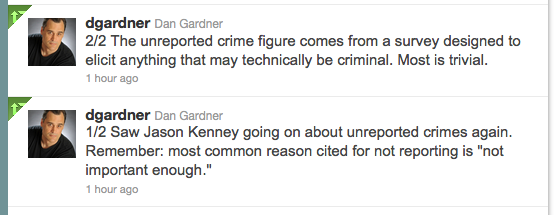
There's good reason for this. The survey as a whole says far more than Gardner says it does, and the data points he himself is offering don't necessarily support his claims about it.

To blithely assume that this means that the victim of the crime in general didn't consider it important enough to report is to also assume that all respondents perceived the meaning of that phrase in a uniform manner. This would be a mistake.
When a response begins and ends with "not important enough", it's every bit as likely that the respondent could conclude that the crime in question was not important enough to the police as not important enough to them personally. In lieu of a better-defined response, either conclusion is equally likely, and it's much more reasonable -- and responsible -- to allow for the probability that those who submitted that response had either of these in mind. Some likely concluded the former, and some likely concluded the latter.
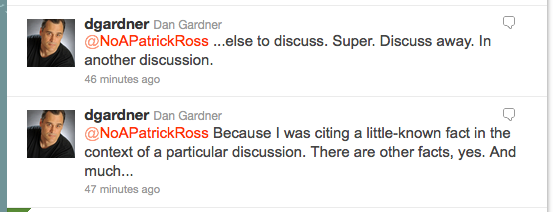
Yet to ask Dan Gardner if the conclusion he reached -- that this response indicates that most of Canada's unreported crime is trivial -- is reasonable considering the ambiguous nature of this data is apparently to precipitate a meltdown on his behalf. If last night's events are any indication, he simply can't cope with that idea.
To ask him about the second-ranked response -- "police could not do anything about it" -- is apparently to make it worse. Gardner's response was that this was a worthy point to be discussed, but that he personally wouldn't. (That the second-ranked response trailed the first-ranked response by less than ten percentage points apparently did nothing to boost the worthiness of this data point in Gardner's eyes.)
It becomes difficult to avoid reaching the conclusion that, in the canon of the far-left media, these are forbidden questions. "Does the data actually indicate what you're saying it does?" That question is forbidden. "Isn't the second-ranked response also worthy of consideration?" That question is also forbidden.
What seems to emerge, in Dan Gardner's case, is that of a man who has not embraced journalism as a means with which to provide people with information or even ideas. Rather, he's embraced the journalistic enterprise purely as a means of political advocacy. Nothing else.
It's hard to escape the conclusion that Gardner is simply a card-carrying member of the media party. The media party has an agenda, and in this case it's in preserving the soft-on-crime, hug-a-thug policies that they claim have reduced crime in Canada, but in reality have not. The Stats Can study itself states that in no uncertain terms -- victimization in Canada has remained stable.
In support of that agenda, Gardner sets out to turn public attention away from specific data points that do not support that agenda, and toward data points that seem to support it only if they go unexamined.
It's one thing to insist that Canadians aren't reporting specific crimes because they're "not important enough", whatever that might mean to the individuals who offered that response.
To insist that the unreported crimes are trivial is remarkably obtuse when one considers what those unreported crimes are:

The fourth was vandalism. That could be a trivial crime, but not necessarily. The sixth and seventh were theft, or personal property and household property respectively. That, too, could be a trivial crime, but not necessarily.
It's not up to Dan Gardner to decide if the unreported victimization of Canadians is trivial. It's up to each individual victim to decide that for themselves and admittedly, many of them might reach that conclusion. Many might not.
But this is how the media party operates: they assume that they speak for Canadians as a whole, then they pretend to.
In the end, Dan Gardner's impotent response to the questions he was asked was to label your not-so-humble scribe a "troll". Basically it amounts to an accusation that the questions over whether or not Gardner has given ample consideration to the meaning of the data points he offers is "inflammatory, extraneous, or off-topic", as Wikipedia would have it.
The questions over whether or not Gardner is accurately interpreting the data offered by this survey are very clearly on-topic. It's simply a question that he considers forbidden: it's entirely reasonable to ask in the face of ambiguous data with a wide berth of potential meanings, but it seems to be Gardner's belief that no one is allowed to ask that question.
To this end, Dan Gardner is wrong. People have the right to ask these questions, and if Gardner, demanding merit in the public eye, refuses to discuss them, then it's he who has abandoned the lofty aspirations of journalism.
It's not what one would expect from a journalist. But it's precisely what one would expect from a member of the media party.
Monday, November 07, 2011
The Scandal Machine Backfires: Sask NDP Admits to Electioneering on Voting Day
When the NDP issued this press release, one can imagine the reaction they hoped to elicit was one of outrage.
Instead, they've drawn attention to what seems like a potential violation of Elections law. The press release, which claims that Saskatchewan Party staffers, including Deputy Chief of Staff to Premier Brad Wall Terri Harris, was issued on November 7, 2011. It claimed that the staffers had been spotted removing NDP door-hangers mere moments after they had been placed:
Certainly, it's awfully nice of them to offer rides to seniors. They can quite easily do that without leaving partisan material behind.
Any Saskatchewan Party staffers encountering the NDP leaving such material behind are certainly not obligated to allow the NDP to break the rules to the Saskatchewan Party's disadvantage. This is, of course, presuming that what the NDP claims is happening at all.
Considering that the NDP were already lying to the people of Saskatchewan before the writ was even dropped, they'll need some evidence. There's no reason to simply take their word for it.
Instead, they've drawn attention to what seems like a potential violation of Elections law. The press release, which claims that Saskatchewan Party staffers, including Deputy Chief of Staff to Premier Brad Wall Terri Harris, was issued on November 7, 2011. It claimed that the staffers had been spotted removing NDP door-hangers mere moments after they had been placed:
"The Sask Party operatives were removing NDP literature which helped the senior renters know where and when to vote, and offering rides to voters in the bad weather.The problem for the NDP is obvious. It's illegal to campaign on election day, and if they're in a seniors' apartment complex anywhere in the province hanging partisan material on door knobs, they're in violation of the elections act.
'I think she’s seen me,' said Rogochewsky upon being spotted by NDP team members, who had already noticed that literature seemed to be disappearing from doorknobs minutes after it was placed there."
Certainly, it's awfully nice of them to offer rides to seniors. They can quite easily do that without leaving partisan material behind.
Any Saskatchewan Party staffers encountering the NDP leaving such material behind are certainly not obligated to allow the NDP to break the rules to the Saskatchewan Party's disadvantage. This is, of course, presuming that what the NDP claims is happening at all.
Considering that the NDP were already lying to the people of Saskatchewan before the writ was even dropped, they'll need some evidence. There's no reason to simply take their word for it.
When Does a Single Interview Cancellation Constitute a Ban?
The attention-hungry continue to falsely martyr themselves
There's no martyr like a self-made martyr. Over the last year, Canadians have seen far more self-made martyrs than anyone really needs.
Now Margie Gillis, Franke James and Brigette DePape have some strange company among them: Fog of War author Mark Bourrie.
According to Bourrie, he'd been scheduled to appear on Michael Coren's show on the Sun News Network. Later on, that interview was cancelled.
Quickly following the cancellation of his interview, Bourrie wrote a blog post for Ottawa magazine claiming he had been banned.
"Well, that’s it. I’m banned," Bourrie claimed. "I am lower than low, mere scrapings from the bottom of the dog walker’s boot. Yes, I’m not fit to be on the Sun News Network."
"My publicist booked me on Michael Coren’s show a couple of weeks ago. Last Wednesday, I got an e-mail saying the interview had been cancelled by Sun TV," Bourrie continued. "It wasn’t Coren or Coren’s producer who made the decision. Someone higher up had killed the booking and banned me from Sun TV."
The evidence Bourrie offers? Precisely none.
This author hasn't yet had access to Bourrie's book to give it a fair consideration of its merits. So your not-so-humble scribe won't automatically lump Mr Bourrie with mediocre self-made-martyrs like DePape, James or Gillis.
But Bourrie's martyrdom seems no less self-made.
Simply put, one interview cancellation does not a ban make. Bourrie's planned interview on Sun News could have been cancelled for any number of good reasons. Here's a very good one, and a very plausible one: perhaps the topic of episode on which Bourrie was scheduled to appear was changed.
This author doesn't know this to be the case. Nor does this author have any evidence to support it. However, under the evidence already offered -- Bourrie's complaint that his interview was cancelled -- this explanation is no more and no less plausible than Bourrie's.
The obvious difference is that Bourrie's explanation simultaneously lionizes himself while portraying himself as a victim. Bourrie's explanation unfortunately precludes any other possibility that doesn't require Sun News to be the bad guy of the story.
If Mark Bourrie wants to know what a real media ban looks like, this author has a story for him. Unfortunately for Bourrie, it doesn't make him out to be the martyr he seemingly wants to be so desperately, so he may not be interested.
There's no martyr like a self-made martyr. Over the last year, Canadians have seen far more self-made martyrs than anyone really needs.
Now Margie Gillis, Franke James and Brigette DePape have some strange company among them: Fog of War author Mark Bourrie.
According to Bourrie, he'd been scheduled to appear on Michael Coren's show on the Sun News Network. Later on, that interview was cancelled.
Quickly following the cancellation of his interview, Bourrie wrote a blog post for Ottawa magazine claiming he had been banned.
"Well, that’s it. I’m banned," Bourrie claimed. "I am lower than low, mere scrapings from the bottom of the dog walker’s boot. Yes, I’m not fit to be on the Sun News Network."
"My publicist booked me on Michael Coren’s show a couple of weeks ago. Last Wednesday, I got an e-mail saying the interview had been cancelled by Sun TV," Bourrie continued. "It wasn’t Coren or Coren’s producer who made the decision. Someone higher up had killed the booking and banned me from Sun TV."
The evidence Bourrie offers? Precisely none.
This author hasn't yet had access to Bourrie's book to give it a fair consideration of its merits. So your not-so-humble scribe won't automatically lump Mr Bourrie with mediocre self-made-martyrs like DePape, James or Gillis.
But Bourrie's martyrdom seems no less self-made.
Simply put, one interview cancellation does not a ban make. Bourrie's planned interview on Sun News could have been cancelled for any number of good reasons. Here's a very good one, and a very plausible one: perhaps the topic of episode on which Bourrie was scheduled to appear was changed.
This author doesn't know this to be the case. Nor does this author have any evidence to support it. However, under the evidence already offered -- Bourrie's complaint that his interview was cancelled -- this explanation is no more and no less plausible than Bourrie's.
The obvious difference is that Bourrie's explanation simultaneously lionizes himself while portraying himself as a victim. Bourrie's explanation unfortunately precludes any other possibility that doesn't require Sun News to be the bad guy of the story.
If Mark Bourrie wants to know what a real media ban looks like, this author has a story for him. Unfortunately for Bourrie, it doesn't make him out to be the martyr he seemingly wants to be so desperately, so he may not be interested.
Subscribe to:
Posts (Atom)